
TAUUTUUTU HUB
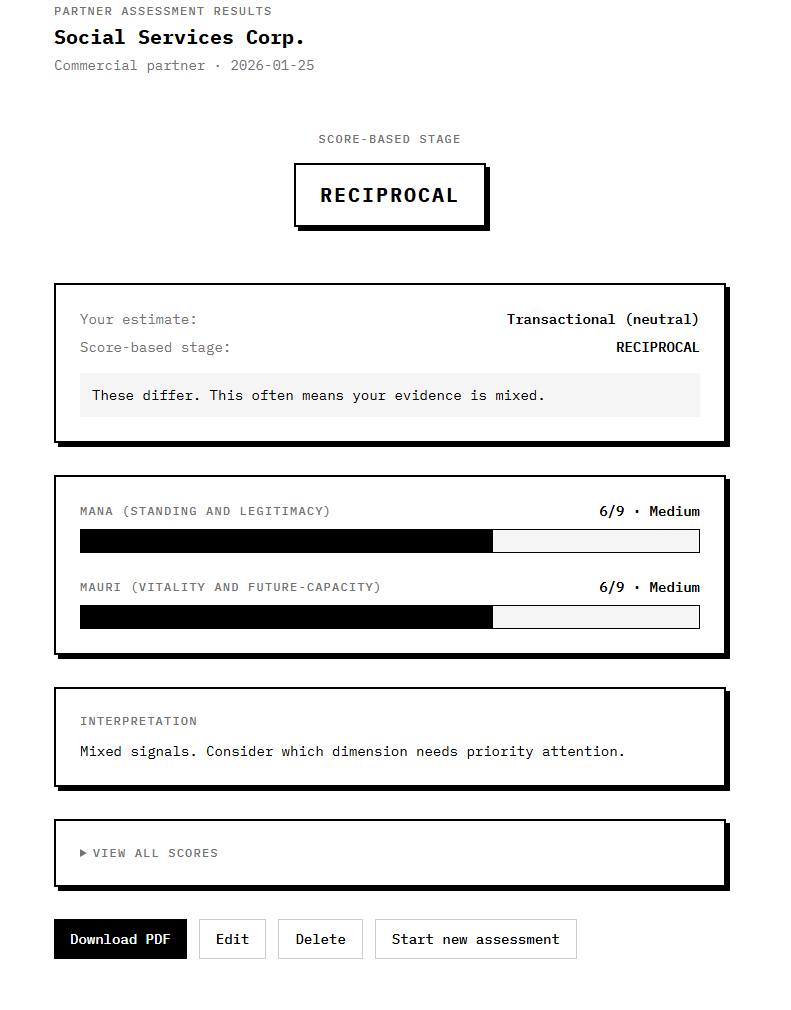
Try the new Tauutuutu self-assessment tool
Read the extensive white paper on Tauutuutu
Eight elements of tauutuutu
Tauutuutu treats performance as a function of relationship quality: reciprocity + escalation + system care.
Whakapapa (networked relationships)
“We are embedded; actions ripple.”
- Better information flow and earlier warning signals.
- Faster coordination across partners and teams.
- Downstream impacts are seen sooner (so they don’t become future costs).
Social capital; network embeddedness; stakeholder theory; systems thinking.
Obligation / reciprocity (utu / tauutuutu)
“Benefits create duties.”
- Less opportunism; fewer enforcement and monitoring costs.
- Higher reliability when formal contracts can’t specify everything.
- More willingness to solve problems rather than litigate them.
Relational contracts; norms as governance; psychological contracts.
Escalation over time (deepening exchange)
“Each exchange deepens the bond.”
- Turns one-off transactions into durable relationships.
- Lower acquisition costs and higher lifetime value.
- Repeat collaboration becomes the default, not the exception.
Repeated games; reputation effects; relationship marketing.
Mana (status / authority / dignity)
“Reputation capital with teeth.”
- Stronger bargaining position and higher-quality partnerships.
- Attracts aligned partners and talent.
- Reduces perceived risk in deals, delivery, and governance.
Signalling; legitimacy; brand and trust.
Mauri (life-supporting capacity)
“System vitality and limits.”
- Builds resilience rather than running the system down.
- Avoids value destruction through degradation and scarcity.
- Protects the resource base future cashflows depend on.
Natural capital; regenerative models; commons governance.
Dynamic equilibrium (ongoing balance)
“Balance is ongoing management.”
- Keeps the system investable over decades, not quarters.
- Avoids short-term optimisation that creates long-term liabilities.
- Improves learning loops: adjust, don’t entrench.
Adaptive governance; continuous improvement.
Redistribution to owner-communities (surplus circulates)
“Surplus circulates to strengthen the base.”
- Builds capability and demand in the owner/community base.
- Strengthens social licence and the future labour pipeline.
- Reinvests in the ecosystem that sustains the enterprise.
Cooperative principles; stakeholder value.
Exchanges with nature (whenua / awa / species)
“Take/return relationship with whenua, awa, and species.”
- Reduces regulatory and consenting risk (fewer nasty surprises).
- Supports premium positioning with credible practice, not slogans.
- Protects biophysical foundations of long-run production.
Commons governance; stewardship; environmental economics.